Second Serve
MFA Design for Sustainability Thesis | Circular Economy | Branding + Strategy Design


Timeline: October 2024 to May 2025 (8 Months)
Committee: Scott Boylston (Grad Coordinator for DfS at SCAD), Satyakam Sharma (DfS Professor at SCAD), Shannon Iacino (ID Professor at SCAD)
Tools: Photoshop, Illustrator, InDesign, Figma
Project Overview: Second Serve addresses the growing issue of premature tennis racket abandonment and lack of circular systems in the sports industry. By collecting, refurbishing, and redistributing used rackets, Second Serve creates a closed-loop model that reduces waste, promotes reuse, and increases access to equipment. The project benefits players, communities, and the planet through sustainable, scalable impact.
Inspiration: As a tennis player and fan, attending the US Open in Summer 2023 was a dream come true. I saw legends like Novak Djokovic, current world No. 1 Jannik Sinner, and my personal favourite, Andrey Rublev, play live – it was unforgettable. But amid the excitement, I couldn’t help noticing the absence of meaningful sustainability efforts at an event hosting over a million attendees. That moment sparked a deeper realisation: despite their global influence, the worlds of sports and sustainability rarely intersect. Second Serve emerged from this gap; an initiative rooted in circular economy principles to embed sustainability within the sports industry.
Thesis Abstract
This research explores the norms of the tennis racket industry and the various behaviors and consumption practices of tennis players (or tennis racket users) with respect to their equipment in Ahmedabad, India. Through conversations and inquiries, the research analyses player consumption practices and the role of influencing bodies in promoting this consumption. By leveraging stakeholder relationships and the business as usual behavior, this research explores strategies to implement a circular business model within the tennis racket industry. Second Serve, is a service-centric circular economy business model and initiative to promote awareness and healthy consumption as well as reduce resource wastage. Furthermore, the study presents a replicable business model design for similar products and equipment within and beyond the sports industry.

Visual Identity
The visual identity of Second Serve is designed to reflect its core values: circularity, transformation, and clarity of purpose. As a brand rooted in sustainable systems thinking, its visual language aims to communicate not just aesthetics, but intention – bridging the gap between environmental responsibility and design sensibility.The logo features a custom wordmark, with the letter “O” reimagined as a tennis racket with an arrow indicating closing of a loop – a direct nod to the product at the center of the system – symbolising continuity and circularity. This visual cue connects the identity to the sport while reinforcing the brand’s mission to give equipment a second life.


Conceptualisation + System
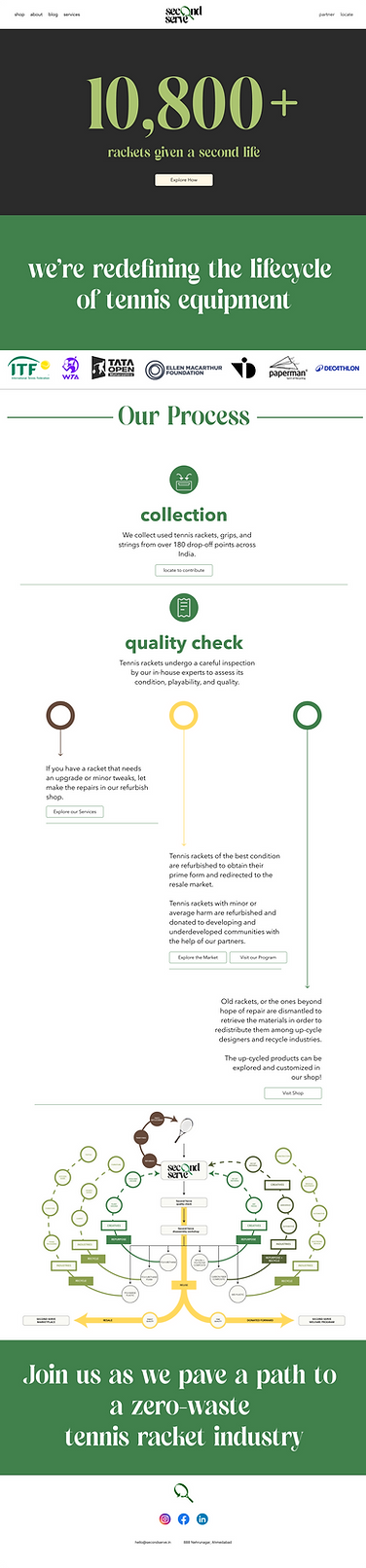
The process begins with localized collection—partnering with tennis academies and individual players who are ready to part with their old equipment. Rackets are then sorted into three categories based on quality check and condition. Top quality rackets that are nearly new and are diverted to a second hand marketplace, the rackets that are in a relatively good condition are cleaned, refurbished, and donated to under-resourced programs, and damaged or outdated ones are sent for disassembly. The quality check is performed in-house by material experts based on scratches or dents on frame, paint chips, structural integrity, grommet strength, under grip quality, internal balance and vibration, and brand and model demand.
Refurbish: Second Serve offers refurbishment services that include racket examination and repair, paint jobs, and parts replacement. These practices restore both function and appearance, extending the life of lightly used rackets. By maintaining equipment already in circulation, Second Serve reduces unnecessary waste and encourages players to choose repair over replacement—supporting a more sustainable and circular approach to tennis.


Resale and Donation: After a thorough quality check, usable rackets are directed into Second Serve’s reuse stream. Top-tier rackets that are in high demand are listed on the Second Serve marketplace, offering consumers high-quality equipment at significantly reduced prices. Slightly older but still functional rackets are donated through the welfare program, in collaboration with NGOs, ITF, and government bodies. This initiative supports access to tennis in under-resourced communities, bridging the gap between excess and need. By combining resale and donation, Second Serve not only diverts waste from landfills but also makes the sport more inclusive and accessible through circular redistribution.
Disassembly and Distribution: The disassembly phase focuses on separating key components with different materials manually: frame, bumper guard and grommets, handle undergrip, butt cap, grip, and strings. These materials are then redistributed to relevant industries that can apply proper treatment and recycle or repurpose them. This system not only reduces material waste but creates opportunities for collaboration across the value chain – from sports communities and recyclers to designers and artists.


Web Layout
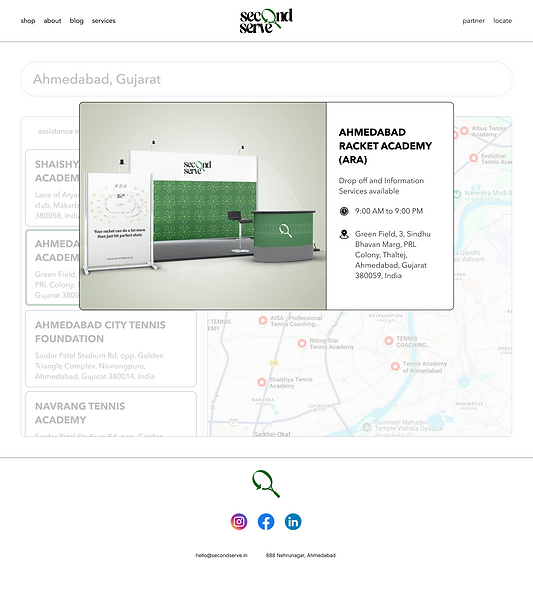
The Second Serve website functions as the central digital hub for the audience. Designed with accessibility and clarity in mind, the platform offers users — from players to partners — a seamless journey through donation, education, and impact. The site is divided into intuitive sections: “Donate” guides consumers through the giving process; “Shop” offers refurbished rackets (and more) at accessible prices; and “About” provides insight into sustainable practices in sports. B2B partners can explore collaboration opportunities through tailored pathways.
Visuals are minimal yet engaging, prioritizing storytelling through clean UI, detailed infographics, and real-time impact metrics. The website not only facilitates action but also fosters awareness, extending Second Serve’s mission beyond physical spaces and into digital spheres — encouraging users to play their part in a more sustainable sporting future.


Shop


Locate